

Summary
Letara, a Hokkaido University spinout, has closed approximately ¥2.6 billion (roughly $16 million) in funding to develop hybrid rocket engines that use plastic as fuel and are not legally classified as explosives, enabling applications from satellite thrusters to launch vehicles and defense systems.
Japan's Push into Commercial Space
Japan is channeling billions of dollars into its emerging space industry and relaxing restrictions on defense exports in a coordinated effort to build a homegrown aerospace sector with global reach. Against this backdrop, Sapporo-based startup Letara has announced the close of approximately ¥2.6 billion (roughly $16 million) in funding, marking a significant step forward for Japan's commercial space ambitions.
Letara, a spinout from Hokkaido University, specializes in developing hybrid propulsion systems for spacecraft. After initially focusing on hybrid thrusters for small satellites, the company now plans to develop large rocket systems for space, defense, and security markets, according to co-CEO Shota Hirai. The funding round was co-led by Headline Asia, JIC Venture Growth Investments, and Incubate Fund, with strategic participation from energy company NES Corporation, Toyota Group rubber and plastic automotive components supplier Toyoda Gosei, and Frontier Innovations, an investment fund backed by the Japan Aerospace Exploration Agency (JAXA).
The Technical Advantage of Hybrid Rocket Engines
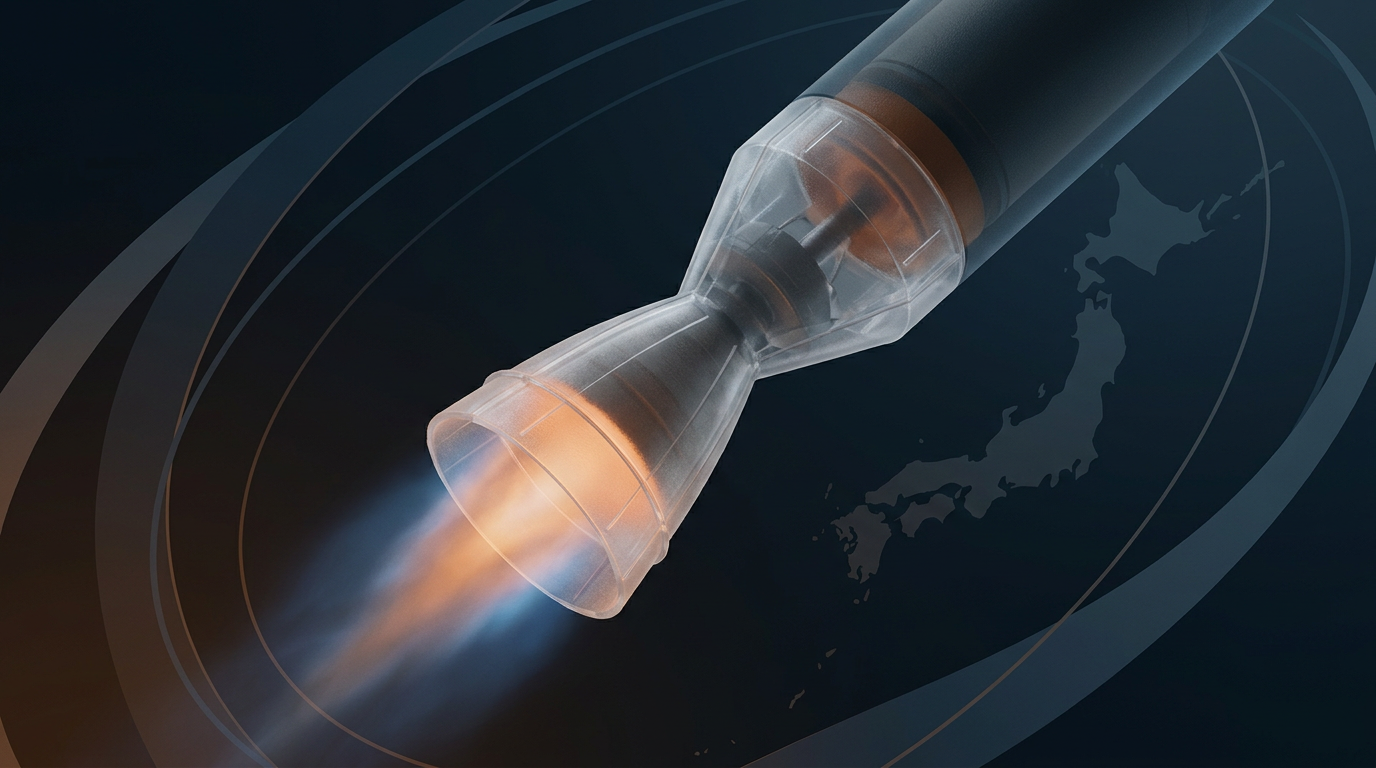
At the core of Letara's technology is a hybrid rocket design that keeps solid fuel separate from the liquid oxidizer required for combustion. The company uses inexpensive, widely available materials such as plastic and rubber as solid fuel, and has developed a proprietary manufacturing process to mix, shape, and compress these materials.
This design delivers significant practical advantages. Because the propellant does not meet the legal definition of an explosive, it changes how the fuel is stored, transported, and handled, substantially reducing operational complexity and costs. Traditional rocket fuels typically require stringent safety measures and specialized storage facilities, whereas Letara's hybrid system simplifies these processes.
The concept of hybrid rocket engines is decades old, but has always faced the same technical challenge: achieving stable ignition and thrust comparable to conventional engines proved difficult. Letara claims that its fuel design and patented ignition system now match the performance of solid motors and liquid bipropellant systems.
Scaling from Satellite Thrusters to Launch Vehicles
Letara's commercial strategy revolves around scalability. The company has miniaturized its engines to palm-sized units suitable for small satellites, while the same technological approach scales up to launch vehicle class. This flexibility allows Letara to serve multiple segments of the space market, from commercial satellite operators to defense contractors.
With this round, we will go beyond demonstrating that thruster in space, Hirai explained. We plan to explore a much wider set of use cases across both the space domain and the defense and security domain, and to develop and propose hybrid rocket systems suited to each of them.
Notably, Letara has already secured orders from rocket and satellite manufacturers as well as the Japanese government, though specific contract values have not been disclosed. The company is also registered as a JAXA partner startup, underscoring its position within Japan's space ecosystem.
Unusual Institutional Investor Participation
The investor roster for this funding round is unusually institutional for a rocket company. Japanese banks, insurers, and automotive parts group Toyoda Gosei all participated, alongside venture arms of SMBC and Mitsubishi UFJ Financial Group.
This investor composition reflects growing interest from Japan's traditional industries in space technology, as well as these enterprises' strategic efforts to diversify and participate in emerging high-tech sectors. The participation of automotive suppliers like Toyoda Gosei is particularly noteworthy, as their expertise in rubber and plastic materials may create synergies with Letara's fuel technology.
The presence of institutional investors also suggests confidence in the commercial viability of hybrid rocket technology. Unlike early-stage venture capital, institutional investors typically require clearer paths to revenue and more conservative risk profiles, indicating that Letara's business model and technical approach have passed rigorous due diligence.
Next Milestone: In-Orbit Firing Test
Letara's next critical milestone is an in-orbit firing test with an overseas partner. This step is essential for any propulsion technology company, as it separates theoretical capabilities from demonstrated performance. Successfully demonstrating engine performance in the space environment will validate the technology's commercial viability and pave the way for subsequent orders and partnerships.
The success of in-orbit testing will enable Letara to provide actual performance data to potential customers, which is crucial for procurement decisions in the aerospace industry. Given the orders the company has already secured, this test could accelerate commercial deployment of its products.
In-orbit demonstrations also serve as powerful marketing tools in the space industry. A successful test generates credibility that no amount of ground-based testing can replicate, as it proves the technology functions in the harsh conditions of space, including vacuum, radiation, and thermal extremes.
Global Competitive Landscape
Letara is not alone in pursuing hybrid rocket engine technology. Germany's HyImpulse raised €45 million for the same approach last October, indicating that this field is heating up globally. Europe appears further along in this technology, but Japan's strong government support and Letara's close ties with JAXA may provide unique competitive advantages.
The fact that multiple companies worldwide are simultaneously investing in hybrid rocket technology suggests the industry recognizes genuine commercial potential in this approach. As the commercial space market continues to expand and demand for small satellite launches grows, companies that can provide cost-effective, operationally simple propulsion solutions will be well-positioned.
The competitive landscape also highlights different regional approaches to space technology development. European companies like HyImpulse have benefited from the continent's strong aerospace heritage and established supply chains, while Japanese companies like Letara leverage Japan's materials science expertise and manufacturing precision. This diversity of approaches may ultimately benefit the industry by producing multiple viable solutions for different market segments.
Implications for Japan's Space Industry
Letara's funding and development plans are part of Japan's broader space industry strategy. The Japanese government is actively cultivating domestic space capabilities not only for scientific exploration but also for national security and economic competitiveness. Relaxing defense export restrictions opens new market opportunities for Japanese space companies, particularly in defense and security sectors.
The government's substantial financial commitment to the space sector signals long-term strategic intent. Japan recognizes that space capabilities are increasingly critical for communications, navigation, Earth observation, and national security. By supporting companies like Letara, Japan aims to reduce dependence on foreign space technology and create export opportunities for Japanese aerospace products.
For observers in the digital asset and blockchain industries, developments in the space industry also carry long-term significance. As satellite communication networks expand and space infrastructure develops, new application scenarios may emerge, such as satellite-based blockchain nodes and space data markets. While these applications remain conceptual, advances in propulsion technology form the foundation for realizing such visions.
Technical and Regulatory Considerations
The regulatory advantage of hybrid rocket engines that they are not classified as explosives cannot be overstated. This classification affects every aspect of the supply chain, from manufacturing facilities to transportation logistics to launch site operations. Companies working with traditional rocket propellants must navigate complex regulatory frameworks governing explosive materials, which vary by jurisdiction and can significantly increase costs and timelines.
Letara's approach potentially simplifies international collaboration and export. Explosive materials face strict export controls and international transportation regulations, whereas materials not classified as explosives face fewer restrictions. This could make it easier for Letara to work with international partners and serve global markets.
However, the technology still faces technical validation requirements. Aerospace customers demand rigorous performance data and reliability metrics before committing to new propulsion systems. Letara's planned in-orbit test will provide some of this data, but building a track record of successful missions will take time.
Market Opportunities and Challenges
The market for satellite propulsion systems is growing rapidly, driven by the proliferation of small satellite constellations for communications, Earth observation, and other applications. Companies deploying hundreds or thousands of satellites need cost-effective, reliable propulsion systems for orbital maneuvering and end-of-life deorbiting.
Letara's ability to scale its technology from small satellite thrusters to large launch vehicle systems positions it to serve multiple market segments. However, each segment has different requirements and competitive dynamics. Small satellite propulsion faces competition from electric propulsion systems and other chemical propulsion approaches, while launch vehicles compete in a market dominated by established players with decades of heritage.
The defense and security market represents another significant opportunity, particularly as Japan relaxes defense export restrictions. Military and intelligence satellites have specific requirements for reliability, performance, and operational flexibility. Letara's hybrid approach may offer advantages in some of these applications, but entering defense markets typically requires extensive qualification processes and long sales cycles.
Looking Ahead
Letara's case demonstrates how Japan is leveraging its traditional strengths in materials science and manufacturing processes to establish competitive positions in emerging commercial space sectors. As the company advances toward in-orbit testing and expands its product line, its success could inspire more Japanese startups to enter this field, further driving development of Japan's space industry.
The convergence of institutional investment, government support, and technical innovation positions Letara as a company to watch in the global space propulsion market. The upcoming in-orbit test will be a critical validation point, and successful demonstration could catalyze broader adoption of hybrid rocket technology.
For the broader space industry, the progress of companies like Letara and HyImpulse suggests that hybrid rocket engines may finally be overcoming the technical challenges that have limited their adoption for decades. If these companies can deliver on their performance promises while maintaining the operational advantages of non-explosive propellants, hybrid engines could capture significant market share across multiple applications.
The story also illustrates how advances in materials science, manufacturing processes, and engineering can unlock new approaches to longstanding technical challenges. As the space industry continues to evolve from a government-dominated sector to a diverse commercial ecosystem, innovations like Letara's hybrid propulsion systems will play important roles in expanding access to space and enabling new applications.
Source: link